
Canadian Identification and Health Card Documentation: A Complete Guide for Newcomers
Navigating Canadian identification and health card documentation is one of the most important steps for newcomers and residents in Canada. Proper documentation is essential for accessing healthcare, employment opportunities, banking services, and government benefits.
Whether you are settling in Ontario, Alberta, or British Columbia, understanding the required documents for identification and provincial health coverage can help you avoid delays and settle into Canadian life more smoothly. Rules and processing times can change, and requirements sometimes vary by individual circumstance. Always confirm current details on the official government website before applying.
The Foundation of Canadian Identification: The Permanent Resident (PR) Card
For permanent residents, the Permanent Resident (PR) card is the primary proof of status in Canada. It confirms your right to live and work in the country and is one of the most important documents a newcomer will carry.
Most newcomers do not need to apply separately for their first PR card. Once you become a permanent resident, your card is automatically mailed to you if you provide:
- A valid Canadian mailing address
- A compliant photo within 180 days
If you finalize your permanent residence at a Canadian port of entry, you can submit your address directly to the border officer.
READ MORE:
- How to Find Jobs in Canada: The Complete 2026 Guide to Resumes, Interviews & Networking
- Best Ways to Send Money from Canada: A Comprehensive 2026 Guide
- How to Find Housing in Canada as a New Immigrant (2026 Guide)
Important PR Card Details
- PR cards are usually valid for five years
- Lost, stolen, or damaged cards must be replaced through the Permanent Residence Portal
- If you are outside Canada without a valid PR card, you must apply for a Permanent Resident Travel Document (PRTD) before returning on commercial transportation
For the official rules on renewals and replacements, check IRCC’s PR card page directly.
Social Insurance Number (SIN): Working and Accessing Government Benefits
A Social Insurance Number (SIN) is a unique nine-digit number required to:
- Work legally in Canada
- Access government programs and benefits
- File taxes
Because the SIN is highly sensitive, protecting it from misuse is extremely important.
Temporary vs Permanent SINs
- Temporary residents receive a SIN beginning with the number “9”
- Permanent residents and Canadian citizens receive a SIN that does not expire
Applications can be completed online through the eSIN portal, where uploaded identification documents must be clear and readable.
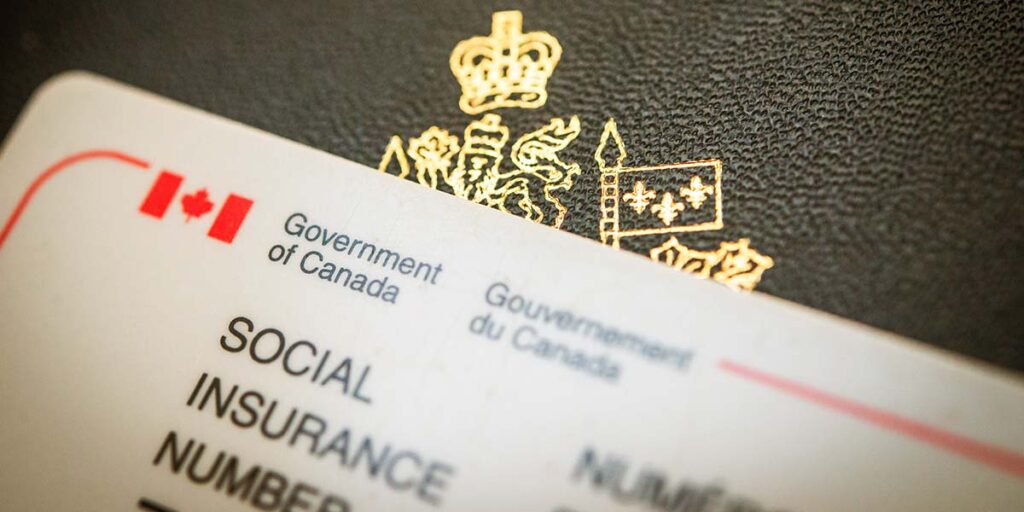
Service Canada no longer issues plastic SIN cards. Instead, applicants receive a paper confirmation document as proof of their SIN.
Provincial Health Card Documentation Requirements in Canada
Healthcare in Canada is publicly funded, but coverage is not automatic. Every resident must apply for a provincial health card after establishing residency.
Each province sets its own rules for provincial health coverage, so requirements can differ depending on where you live.
1. Ontario Health Insurance Plan (OHIP)
To apply for an Ontario health card, applicants must present three separate original documents.
Required OHIP Documents
Proof of citizenship or immigration status: a Canadian passport, Permanent Resident card, or valid work permit with proof of full-time employment for at least six months.
Proof of Ontario residency: an Ontario driver’s licence, utility bill, or residential lease agreement.
Proof of identity: a document with both your name and signature, such as a credit card, student ID, or foreign passport.
For the full, current OHIP document list, see Ontario’s official page.
2. Alberta Health Care Insurance Plan (AHCIP)
New residents in Alberta should register for AHCIP within the first three months of moving to the province.
Required AHCIP documents: government-issued photo identification, proof of Alberta residency, and proof of Canadian immigration status.
Waiting period: if you move to Alberta from outside Canada and apply within 3 months, coverage can start on the date you establish residency. If you move from another province, coverage begins on the first day of the third month. If you experience a gap in health coverage, you may want to consider temporary private health insurance.
3. British Columbia BC Services Card
In British Columbia, residents enrolled in the Medical Services Plan (MSP) receive a BC Services Card. The card includes a unique Personal Health Number (PHN), which remains with you for life.
Requirements: most adults must visit an ICBC driver licensing office, provide two pieces of identification, and have their photograph taken. Some individuals under 18 or over 75 may qualify for a non-photo BC Services Card.
You can review the full requirements on Health Insurance BC’s official site.
Opening a Bank Account in Canada
Opening a Canadian bank account is essential for managing finances, receiving income, and building credit history. Most banks require two original identification documents, including at least one photo ID.
Commonly Accepted Banking Documents
Photo identification: a Canadian passport, foreign passport, PR card, or NEXUS card.
Immigration status documents: a work permit, study permit, or Confirmation of Permanent Residence (COPR).
Proof of address: a utility bill, rental agreement, or employment letter.
Is a SIN Required to Open a Bank Account?
A SIN is not required to open a basic bank account in Canada. However, banks may request it for interest-bearing accounts due to tax reporting requirements.
Federal banking regulations also prevent banks from denying basic accounts solely because:
- You do not have a credit history
- You lack a permanent address
Valid identification remains the primary requirement.
What to Do if Your Identification or Health Card Is Lost
Losing important Canadian identification and health card documentation can create serious problems, including the risk of identity theft. Taking immediate action is essential.
Lost PR Card Inside Canada
- Notify Immigration, Refugees and Citizenship Canada (IRCC)
- Apply for a replacement card
Lost PR Card Outside Canada
- Apply for a Permanent Resident Travel Document (PRTD) before returning
Lost BC Services Card
- Photo cards should be reported to ICBC
- Non-photo cards should be reported to Health Insurance BC
Lost Alberta Health Card
Replacement cards can be obtained by:
- Contacting an authorized registry agent
- Calling the AHCIP office directly
Final Thoughts
Understanding Canadian identification and health card documentation is essential for successfully settling in Canada. From obtaining your PR card and SIN to registering for provincial healthcare and opening a bank account, having the correct documents prepared can save time, reduce stress, and help you access important services quickly.
Ready to Start Your Journey in Canada?
At Loonie Guide, we cover the practical side of settling in Canada, from your PR card and SIN to provincial health coverage and opening your first bank account. Explore our newcomer guides below for the next steps in your move.
Frequently Asked Questions on Canadian identification and health card documentation
1. What is the waiting period for Alberta health coverage?
If you’re moving to Alberta from outside Canada, you may qualify for health coverage from the date you establish residency, provided you apply within three months and meet the eligibility requirements. If you’re moving from another Canadian province, coverage generally begins on the first day of the third month after establishing residency.
2. Can I open a bank account without a permanent address?
Yes. Many Canadian banks accept temporary addresses, including:
- Hotels
- A relative’s address
- Settlement agency letters
3. What happens if I lose my PR card while outside Canada?
You cannot return to Canada using commercial transportation without either:
- A valid PR card, or
- A Permanent Resident Travel Document (PRTD)
You must apply for a PRTD before returning.
4. Is a SIN required for health card applications?
A SIN is generally not required for provincial health card applications. Most provinces primarily require proof of immigration status and residency.
5. How do I get a Personal Health Number (PHN) in British Columbia?
Your PHN is automatically issued when you enroll in British Columbia’s Medical Services Plan (MSP). It appears on your BC Services Card and serves as your lifelong healthcare identifier.


Financial Terms for New Canadians: A Glossary
Learn the key financial terms every new Canadian needs to know, from credit scores and TFSA to taxes, mortgages, and registered savings accounts.

Student Loan Repayment Strategies in Canada That Actually Work
Paying off student debt takes planning. Explore practical student loan repayment strategies, budgeting tips, and support options.

Present Value vs Future Value: What’s the Difference?
Money changes value over time. Understand present value vs future value and how they help with investing, loans, and planning.